
26mm Point
Content updated: 2022-01-25
File last modified:
Page Sections: Background, Clovis, Folsom, Plainview , Eden.
Related Pages:
Stone Tools,
Prehistoric Beringia
All points on this page are shown at roughly their natural size.
By the time of European settlement, much of North America was littered with stone projectile points of various sizes.
This modern reproduction of a traditional arrow-head (at left) is a typical example. It is made of chipped flint, recouched to provide a sharp point and a cutting edge, and is provided with a pair of notches so that it can be tied ("hafted") to the end of an arrow. (Even more arrows simply had fire-hardened wooden points, but of course far fewer of these survived.)
(Usage note, amusing aside.)
Projectile points have been found in a wide range of shapes and sizes —what was needed to kill a bird with an arrow was different from what was needed to kill a bison with a spear— and they were made of a range of kinds of stone, depending on what was locally available. Archaeologists have created typologies based on both form and function to help in reconstructing the history of human settlements in particular regions.
It often happens in archaeology that a particular type of artifact becomes the diagnostic sign for a whole assemblage, and can give its name to whole cultural traditions and groups of people. In the archaeology of early North America, this is the case for two distinctive styles of very early spear points, called Clovis and Folsom, and the use of these points dominates what we know today about the "Clovis People" and the "Folsom People."
Certain characteristics are common to both of these point types:
This page reviews those two early artifact types and a couple of others. Depending on the size and resolution of your screen, the pictures should be approximately life-size.
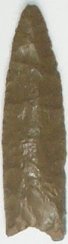
Clovis points (at right) are the oldest spear points widely found in North America, occurring over a vast area covering nearly all of what is today the United States and Mexico. Similar, probably related, points have also been found in Alaska. The broad distribution suggests that there was no "Clovis" ethnic group as such, but simply a tool type (or tool kit) that was broadly shared across many populations.
(Some rather scant archaeological remains antedating Clovis points suggest that the Clovis-point makers were not necessarily the earliest North American population.The Paisley Caves site in Oregon excavated in the early 2000s produced material considered pre-Clovis. And finds in the 20-teens from the Gault site north of Austin, Texas, include artifacts dated to between 14,700 and 19,700 BC. In general, although Clovis is not the earliest artifact style in North America, earlier artifacts do not [seem to] have anywhere near the density or wide geographical spread of Clovis.)
Most Clovis points date to the very end of the Pleisocene, about 9500 to 9000 BC or so, and are associated especially with bones of mammoths (specifically Mammuthus columbi), although they seem also to have been used to hunt bison and other animals. One Clovis site in Montana has suggested use of this technology as early as about 12,000 BC.
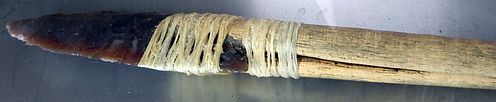
Although the people making and using Clovis points are sometimes described as “mammoth hunters,” Clovis points have never actually been found embedded in mammoth remains, and too few are broken to be consistent with their sometimes hitting heavy mammoth bones with great force. Careful experiments with reproductions of them, published in 2021 (source), strongly suggest that they would only rarely have been capapable of penetrating a mammoth deeply enough to enter a vital organ. Although few specialists see them as essentially butchering knives, it now seems improbable to see them as appropriate primarily for the hunting of very large animals.
There are no known northeast Asian analogs to the Clovis Point, which seems to have been invented in the Americas. (Ambiguous evidence has implied to some specialists the possibility of proto-Clovis technology coming from Europe about 13,000 BC, but most find this still unconvincing.)
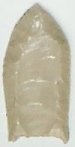
Folsom points (at left) are slightly later —you can think of them as coming in alphabetical order— dating from about 8800 to 8200 BC. They also have a more restricted, although still very wide, distribution, covering the Rocky Mountains and the Great Plains, essentially from slightly north of Montana and North Dakota to slightly south of New Mexico and Texas.
Folsom points seem to be specialized to bison hunting (specifically the now extinct Bison antiquus). Mammoths, found with Clovis points, had disappeared by Folsom times, and bison seem to have become overwhelmingly the large prey of choice. Of course small animals like rabbits and snakes must have been hunted as well.
The most distinctive feature in the appearance of a Folsom point is the huge flute produced by knocking a chip from the center of each side. Clovis points were slighted fluted, but Folsom points were heavily fluted.
Many other Paleoindian spear point types are also identified from Western North America, although they are less well known than Clovis and Folsom, mostly because they are later and have not been associated with the elusive quest for the earliest settlers.
Two examples are Plainview and Eden points.
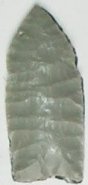
Plainview points (right) were made sometime between 8600 and 7600 BC and, like Folsom points, seem to have been specialized to bison. In that respect we can think of them as successors to the Folsom tool tradition. So far they seem to occur only in the southern areas of the Folsom distribution area, however: largely in Texas, Oklahoma, and New Mexico.
Physically, Plainview Points look similar to Folsom points, but with a much reduced flute or none at all. (Why? If bison hunting spears worked better with fluted points, why did the flutes vanish? If bison hunting spears worked better without the flutes, why were Folsom points so heavily fluted? Was there a technological innovation in hafting that changed things? The world awaits your research.)
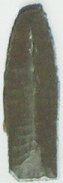
Eden points (left) date from between 7800 and 6500 BC or so. They are distinctive in being extremely long in comparison with their width, although as you can see comparing the example at left with the Clovis one above, that was also often true of Clovis points. Eden points are found over much of the same area as Folsom points. Like Folsom points, they have been associated with bison bones.
Also associated with Paleoindian groups in North America are Scottsbluff points. These are sometimes lumped with Eden points into the "Cody Complex," which also includes some other, less well known point types.
Picture Credits The arrowhead shown at the top of the page was made by an anonymous Cherokee craftsman for sale to tourists. Other photos on this page are of plastic casts available from the "In Hand Museum" collection of Albuquerque. The originals of these particular examples are in the Maxwell Museum of Anthropology at the University of New Mexico. The hafted Clovis point is from the San Diego Zoo. On a desktop computer, points on this page should appear at roughly their natural size.
Unsolicited translations of this page are available as follows. Because they seem to have been produced as translation exercises, the translated pages are not normally updated, links to other pages go back to the original web site, and internal Javascript expansions usually do not function.
Translations no longer available include: French by Jean-Etienne Bergemer, French by Valerie Bastiaan, Hindi by James Galea, Spanish by James Galea, Russian Translation by Alex Marchenko, Ukrainian by Sandi Wolfe, Ukrainian by Nikita Shevchenko.
 visits since 170416.